New York, 2001
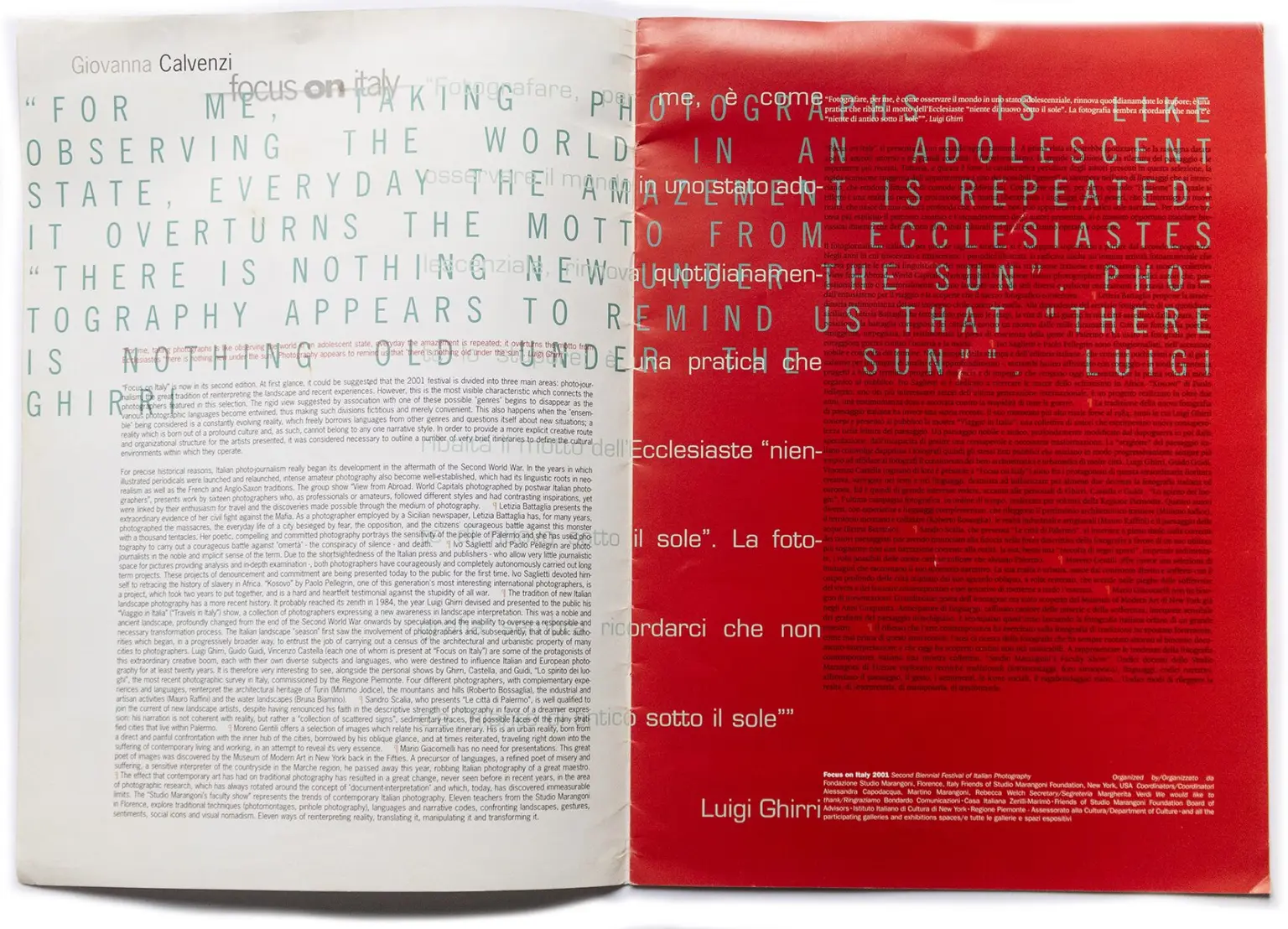
At first glance one might suppose that this 2001 survey is organised around three main currents: photojournalism, the great tradition of reinterpreting the landscape, and the most recent experiences. However – and this is perhaps the distinctive feature of the photographers in this selection – the rigid division suggested by belonging to one of the possible “genres” dissolves in the use of interweaving languages, which make such subdivisions artificial and merely convenient. As indeed it should be when the “whole” under consideration is a reality in constant evolution, freely borrowing languages from other genres, questioning new realities, and springing from a deep culture which, as such, cannot belong to a single narrative style. Nevertheless, to make the creative path and the context of the photographers presented more explicit, it seemed appropriate to trace very brief itineraries defining the cultural spheres in which they have worked and continue to work. For specific historical reasons, Italian photojournalism developed above all after the Second World War. In the years when illustrated magazines were being born and reborn, an intense amateur photographic activity was also taking root, embracing the linguistic roots of Neorealism and of the French and Anglo-Saxon traditions.
The group exhibition “View from Abroad. World Capitals photographed by postwar Italian photographers” presents sixteen photographers who, professionally or as amateurs, worked in different styles and with contrasting impulses, yet were bound together by their enthusiasm for travel and for the discoveries that the photographic medium made possible. Letizia Battaglia presents the extraordinary testimony of her civic commitment against the Mafia. Working for the photographic department of a Sicilian daily newspaper, Letizia Battaglia for years she photographed the massacres, everyday life in a city besieged by fear, the opposition, the citizens’ courageous battle against a monster with a thousand branches. With poetic, heartrending, committed photography, she bore witness to the growing awareness of the people of Palermo and used photography in a courageous war against omertà and death. Ivo Saglietti e Paolo Pellegrin are photojournalists in the noblest and most engaged sense of the term. Amid the short-sightedness of the Italian press and publishing industry, which allows very little room for analytical, in-depth photojournalism, both have courageously and quite independently undertaken long-term projects of denunciation and commitment, which are now presented to the public in a comprehensive way for the first time. Ivo Saglietti has devoted himself to tracing the legacy of slavery in Africa. “Kosovo” by Paolo Pellegrin, one of the most interesting photographers of the latest international generation, is a project carried out over more than two years, a harsh and heartfelt testimony against the stupidity of all wars. The tradition of the new Italian landscape photography, by contrast, has a recent history. Its high point perhaps dates back to 1984, the year in which Luigi Ghirri conceived and presented to the public the exhibition “Viaggio in Italia”, a group show of photographers who expressed a new awareness in reading the landscape. A noble and ancient landscape, profoundly altered from the post-war period onwards by speculation and by the inability to manage a conscious and necessary transformation.
The “season” of the Italian landscape first involved photographers and then the public authorities themselves, which increasingly began to commission photographers to survey the architectural and urban heritage of many cities. Luigi Ghirri, Guido Guidi, Vincenzo Castella (each of them is featured in “Focus on Italy”) are among the protagonists of this extraordinary creative flowering, varied in its themes and languages, which was to influence Italian and European photography for at least two decades. It is therefore of great interest to see, alongside the solo shows by Ghirri, Castella and Guidi , “Lo spirito dei luoghi” (The Spirit of Places), the most recent photographic campaign commissioned by the Piedmont Region. Four different photographers, with complementary experiences and languages, reinterpreting Turin’s architectural heritage (Mimmo Jodice), the mountain and hill country (Roberto Bossaglia), industrial and craft activities (Mauro Raffini) and the waterscape (Bruna Biamino).
Sandro Scalia, who presents “Le città di Palermo”, fully belongs to the current of the new landscape photographers, although he has relinquished faith in the descriptive power of photography in favour of a more dreamlike use of it: his is not a narrative faithful to reality but rather a “collection of scattered signs”, sedimented traces, the possible faces of the many layered cities that inhabit Palermo.
Moreno Gentili instead offers a selection of images tracing his narrative itinerary. His reality is urban, born from a direct and painful confrontation with the deep body of cities, filtered through his oblique, sometimes reiterated gaze, which descends into the folds of the sufferings of contemporary life and work in an attempt to lay bare their essence.
Mario Giacomelli needs no introduction. A great poet of the image, he was discovered by the Museum of Modern Art in New York as early as the 1950s. A forerunner of new languages, a refined bard of poverty and suffering, a sensitive interpreter of the graphic patterns of the Marche landscape, he died this year, leaving Italian photography orphaned of a great master.
The influence that contemporary art has exerted on traditional photography has shifted dramatically – as never before these recent years – the field of research of photography, which has always revolved around the pairing of document and interpretation and has now discovered boundaries that can no longer be measured. Representing the trends of contemporary Italian photography is a group exhibition, “Studio Marangoni’s Faculty Show”. Eleven teachers from the Studio Marangoni in Florence explore traditional techniques (photomontage, pinhole), languages and narrative codes, and tackle landscape, gesture, feelings, social icons, visual wandering… Eleven ways of rereading reality, of interpreting it, manipulating it, transforming it.
Giovanna Calvenzi