Belìce Punto Zero
edited by
Mario Mattia, Maria Donata Napoli, Sandro Scalia.
Texts
Alessandro La Grassa, Mario Mattia, Maria Donata Napoli,
Franco Nicastro, Guido Nicolosi, Gianni Petino, Sandro Scalia,
Historical photographic archive
Biblioteca Centrale della Regione Siciliana “A. Bombace” / Archive of the newspaper L’Ora.
Contemporary photographs
Massimo Cantarero, Alessandra Cremone, Paolo Peloso,
Laura Poma, Sandro Scalia, Francesca Zarba
INGV, Rome 2020
This book was born from an encounter and, like all encounters, from the more or less chance convergence of feelings and ideas. The encounter between researchers and scholars in the field of geology, with their technical knowledge of the root causes of that seismic event; geographers and sociologists, interested in exploring the bonds between population and territory; and finally artists able to distil impressions into images.
Everyone learned something from this encounter: for the geologists, a lesson about “time”, which is no insignificant variable if their work is meant to save lives from events yet to come; for the social scientists, a lesson about how difficult it is to measure the actions and responses of communities when such a radical and traumatic rupture as an earthquake is involved; for the artists, a lesson about the need for cultural and scientific dialogue. The Belìce earthquake, precisely because it was the first of the catastrophic earthquakes of republican Italy, had every requisite to serve as a test case for the medium- to long-term response to an event that shook the very roots of a part of the community. Going back there and comparing today’s images with those of 1968 – in this specific case those published by the daily newspaper L’Ora and acquired by the Biblioteca Centrale della Regione Siciliana “A. Bombace” in Palermo – amounted to a reality check. Has the economic development gap of this part of Sicily been closed? Have the culture and habits that existed before the earthquake been restored? Do the new houses and the new towns meet the aspirations of those who must inhabit and live in those places day after day? What image of the Belìce is conveyed today through
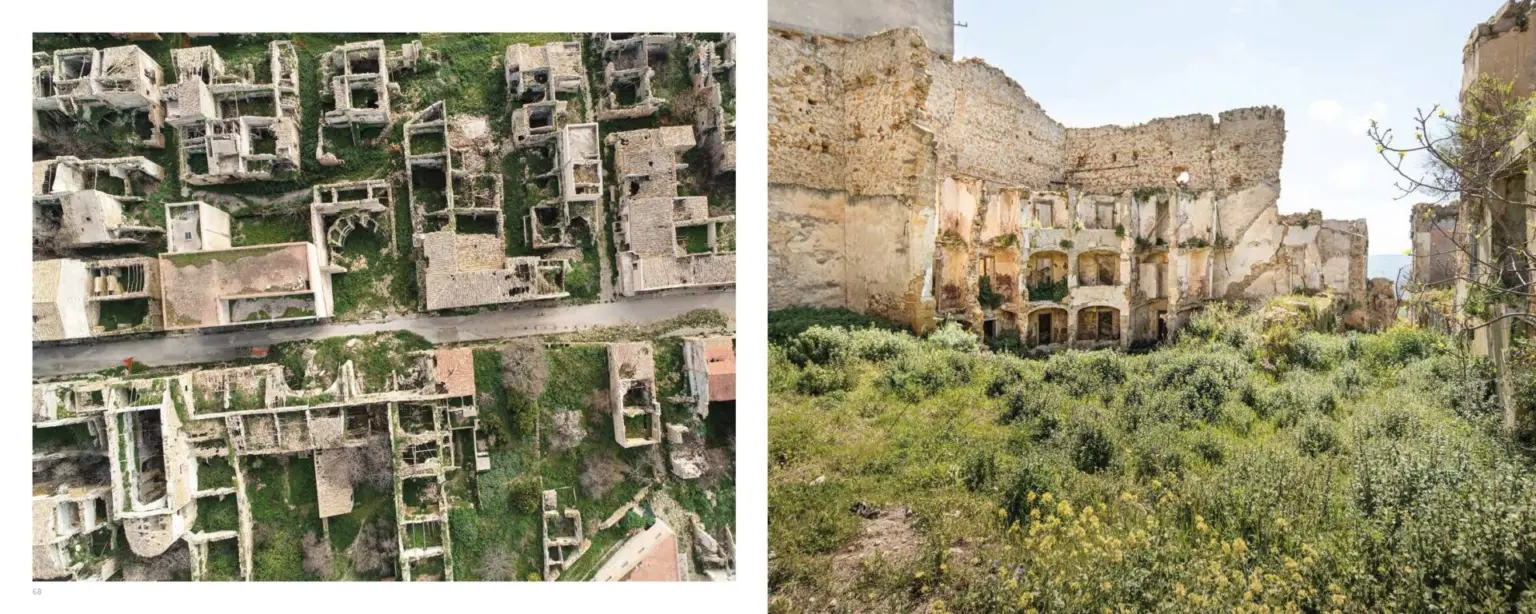
the media and social networks? These, in a nutshell, are the questions that were debated and to which we tried to give an answer through three different levels of interpretation. First, the images: the dramatic ones by the photographers of L’Ora, intent on capturing the tragedy of the affected populations; those from the years following the events, which show us the extreme harshness of an extremely slow and clumsy reconstruction process; and finally those of the Belìce territory as it appears today, with its wounds still open, on display for anyone who still wishes to “look at” the living, still-bleeding body of this social fabric. Then the voices: no interviews, no testimonies, but a synthesis of the words of many, converging in the stories of a few symbolic characters. Finally, the scientific analysis: from the framing of what was already, before the earthquake, a frontier territory, to the contribution of sociological studies and the not always easy relationship with the media.
“There is a moment when the journey you have begun can no longer be interrupted; we run towards a border, we pass through a mysterious door and we wake up on the other side, in another life,” writes Isabel Allende in one of her celebrated books, and this is the obligatory path that the people of the Belìce have been facing for more than fifty years. This sense of “time travel” also inspired the decision to set side by side the photographers of that time, through the wealth of images held at the Biblioteca Centrale della Regione Siciliana “A. Bombace”, and the young students of the photography course at the Accademia di Belle Arti di Palermo, under the guidance of Prof. Sandro Scalia.
Proof, if any were needed, that, as Proust put it, “the real voyage of discovery consists not in seeking new landscapes, but in having new eyes”.
And by comparing images of the past with those of the present, one grasps the paradoxical presence of “emptiness” between the towns of the Valley, as if to underline a top-down reconstruction process that has not even remotely managed to heal the “wound” in the social and cultural body of that part of Sicily, producing instead, as we shall see, stage sets, Instagrammable views and museumified ruins.
A selection from the book