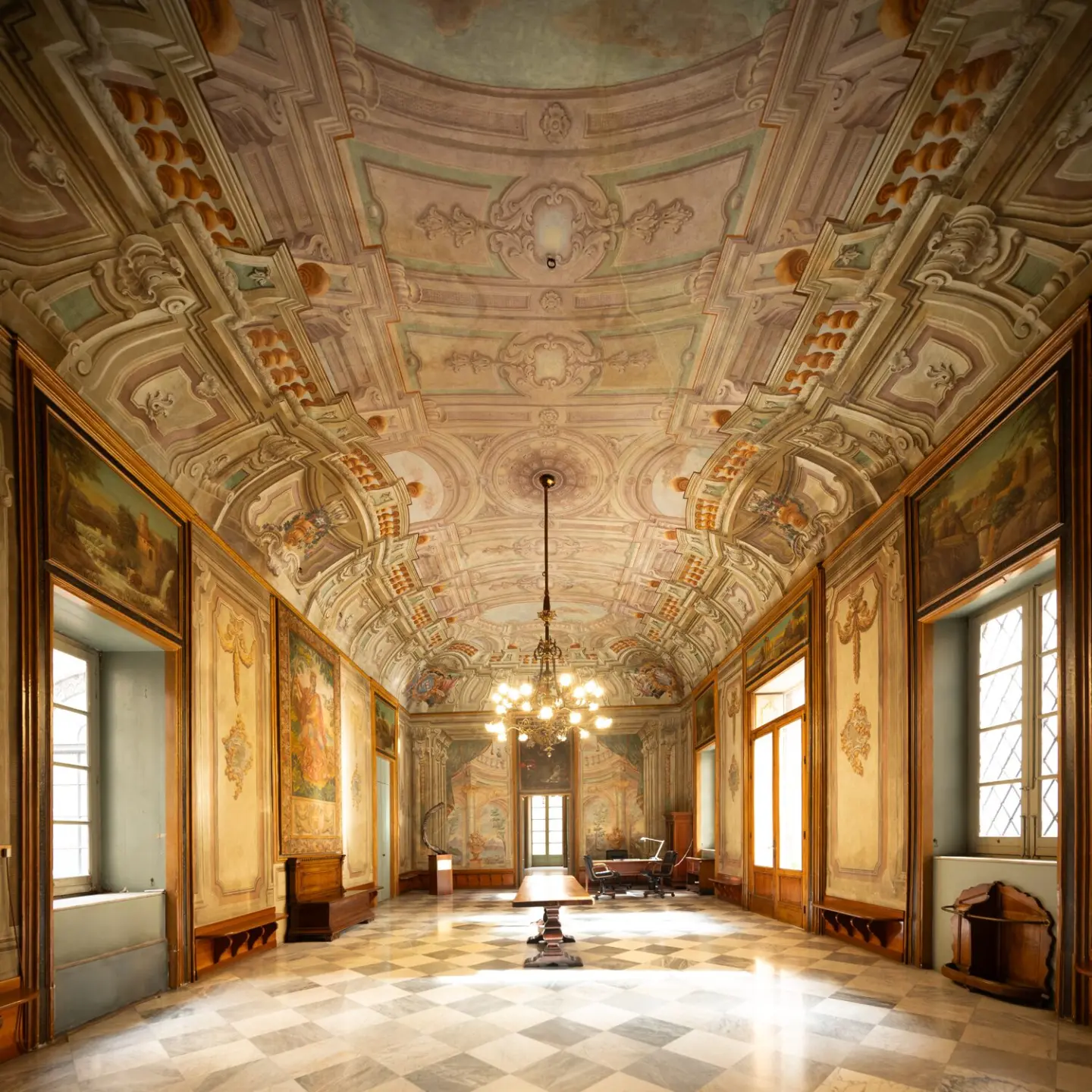
The porcelain cabinets of Palazzo Comitini, Palermo, 2023
In the elaborate decorative schemes of late Baroque palaces, mirrors played a fundamental role; through illusion they refracted the natural light that entered through the windows by day and, by night, reflected that of the enormous Murano glass chandeliers, where hundreds of candles lit the rooms, multiplying the glimmers of the gilded furnishings.
Mirrors are in fact the protagonists of some of Scalia’s photographs of the private rooms of Palazzo Comitini, such as the great alcove chamber of the princes, where the barely perceptible reflection of the Murano glass chandelier is returned by a large oxidised mirror. An evocative image which, through the dark patina deposited on the reflecting surface, gives us the thrill of peering for a moment into a lost time. Of this richly decorated and frescoed room – one of the best-preserved in the palace – we are shown an apparently secondary detail: this dark temporal portal connecting the present to the past, from which the reflected image seems to reach us with melancholy. The same unusual viewpoint, the reflection in the mirror, is used for the Sala Martorana too, while a second, reverse-angle image offers a panoramic view in which the punctum is the portrait (c. 1770) of the Prince of Comitini, Michele Gravina e Gravina, tiny: a blue dot in the immensity of the room.
The perspectival illusionism that characterises most of the frescoes, including Gioacchino Martorana’s (1735-1779) in the gallery, returns in the vestibule, this time entrusted to trompe l’oeilpainting, with quadratura simulating a loggia overlooking a seascape between two theatrical curtains. The contemporary furnishings, a leather armchair and a desk, point to the palace’s current function as an institutional seat.
Among the rooms that have kept their charm intact, the princess’s two boudoirs (c. 1766-1770) represent a summa of the Rococo, the international taste born in France and characterised by grace, lightness and refinement. They form the largest group of photographs in the exhibition: no fewer than nine. An enveloping and intimate portrait of the aristocracy of the time, conveying intact the preciousness of the fixed furnishings and the gallant atmosphere of these private rooms, where ladies withdrew to converse during sumptuous receptions. The two small rooms can be identified as the porcelain cabinets, since the small shelves decorating the walls were used to display collections of Chinese porcelain (since lost, like the original plates), following the fashion for chinoiserie that had spread throughout Europe. In the background, the delicate pastel colours of the boiseries, pink and pale blue, decorated with gilded stucco plant motifs.
Once again mirrors return, here in the form of a precious collection of fifteen engraved Murano mirrors set into the boiseries, depicting genre scenes. The models for these figurative repertoires were French, with scenes of ladies and gentlemen (fête galante), or peasant girls in bucolic settings. One thinks of the paintings of Antoine Watteau, François Boucher and Jean-Honoré Fragonard; in particular the latter’s “The Swing” of 1767, a true manifesto of the Rococo.
Giusi Diana