— Fondazione Studio Marangoni, Strade del reportage, curated by Silvia Marilli and Roberta Valtorta, Florence 1992
— Rencontres internationales de la Photographie Arles (France), Galerie d’Essai, Arles 1995 — Lauréat 1995
— Photographs in the collection of the Galleria Civica di Modena.
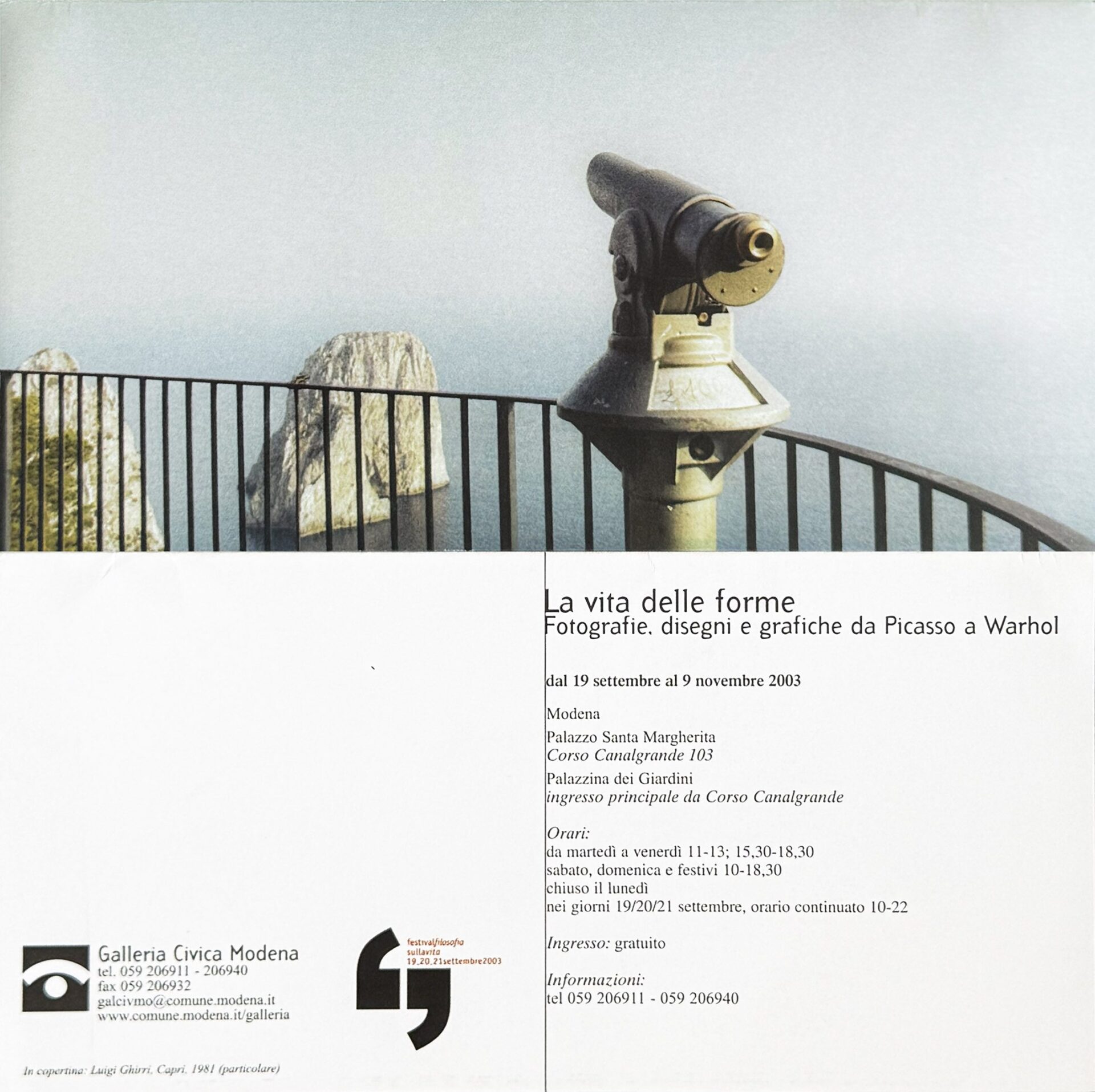
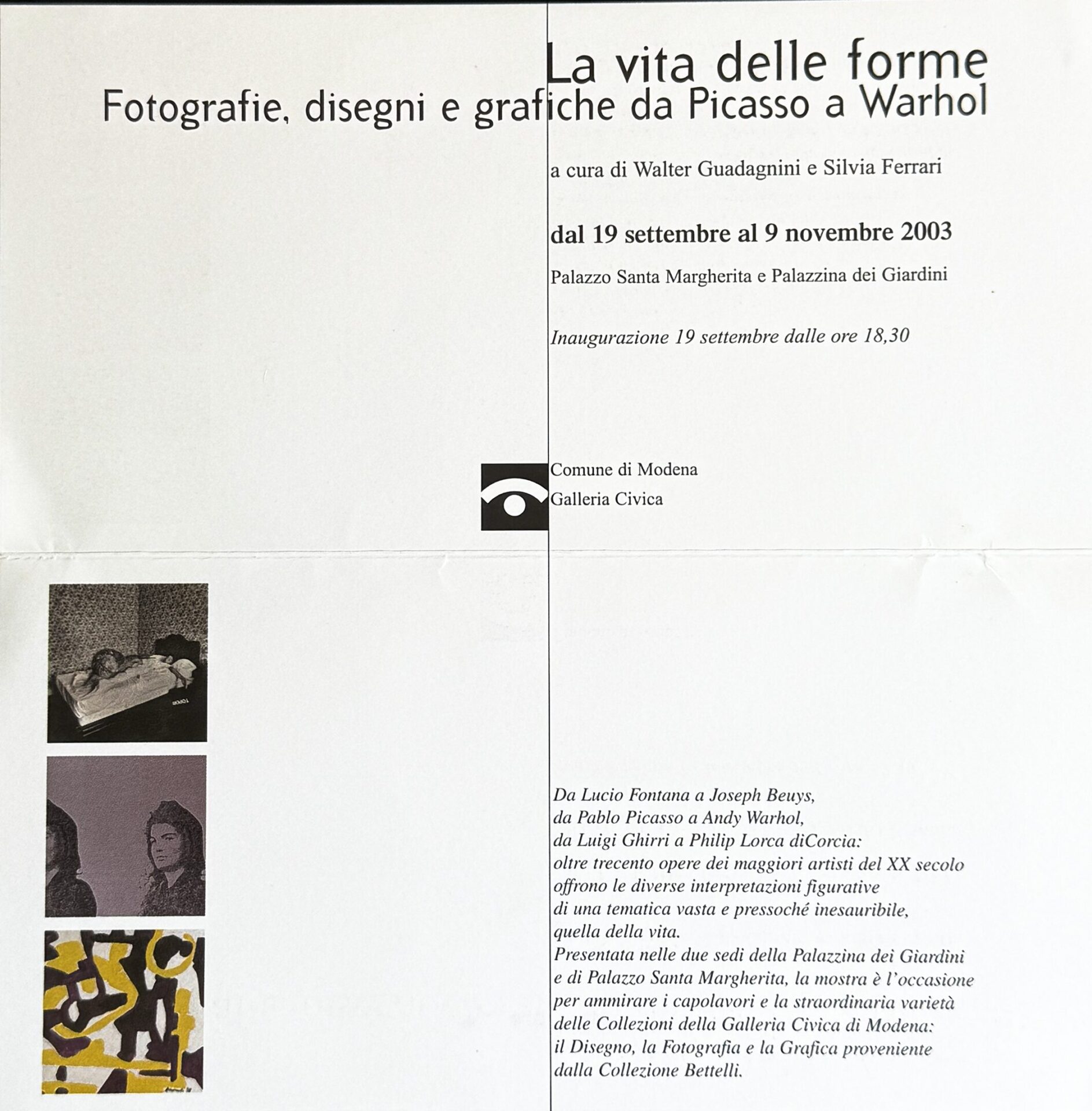
— La vita delle forme. Photographs, drawings and prints from Picasso to Warhol. Curated by Walter Guadagnini and Silvia Ferrari, 19 September – 9 November 2003. Galleria Civica, Palazzo Santa Margherita and Palazzina dei Giardini, Modena.
— Immagini in movimento, Modena per la fotografia, curated by Filippo Maggia, 1996 — Portfolio Prize
Photographic weather report — text by Franco Vaccari
This is the second edition of the national photography competition “Portfolio – immagini in movimento” (images in motion), and it is already possible to detect a meaning in its title that was probably not present when it was conceived.
The organisational centre of the competition is in fact an observation point on the trends in photographic research and on how they evolve. From here, as from a geostationary weather satellite, the eye can take in, in real time, a horizon broad enough to “photograph” not only the present situation but also its dynamics.
The first fact that stands out is the geometric growth in the number of entrants, even though the call for entries was circulated only within very specialised circles. The second is the renewed presence of almost all the most accomplished participants from the previous edition. And here came the surprise that gave the subtitle “images in motion” a broader meaning than intended: the competition’s “regulars”, despite the already sophisticated formal quality of their earlier work, appeared in this new edition in unexpected ways, at the very limit of recognisability.
This goes well beyond the individuals, becoming a sign – or rather a signal – of our times.
One senses a restlessness affecting visual perception, which cannot settle or find peace within a single perceptual system. The gaze of these people, who can be described as professionals of looking, is an agitated gaze, a “bulimic” gaze that bears witness to a difficulty in fixing the object in a satisfying image.
The very rapid changes of register and code are a strategy for coping with the elusiveness of things and situations.
We are a long way from the neorealist outlook, the last one which, in a naïve way, believed in the transparency of the world and in its legibility. Back then it was thought that the problems all lay outside; today we have become suspicious of our own perceptions, and we no longer trust our senses because, among other things, we feel they are inadequate to account for the complexity of reality.
Since the neorealist era – which represents our most authentic tradition – everything has gradually become blurred, as if it were too far away or too close.
There is something moving about the way young people in particular keep trying to grasp an increasingly elusive world through photography.
They bring to mind those incorrigible optimists who, on Sundays, in skin-tight multicoloured suits, pedal across a landscape that has become abstract and obscurely dangerous.
The competition’s formula, which asks participants to explain the reasons for their work, is very interesting. The very fact of accompanying the images with a written text reveals the need to integrate sensory data with more conceptual elements in order to achieve a kind of cognitive synergy.
Characteristic of the tendency to merge elements that until recently were carefully kept apart,
…Of great visual impact is the work by Sandro Scalia “l’occhio insolente” (the insolent eye), in which the power of the images is combined with the assurance with which an unusual technique is mastered. The physical involvement, which we have seen to be practically a constant of the works submitted, here shows itself in the craftsmanship that must have been required to produce such prints…